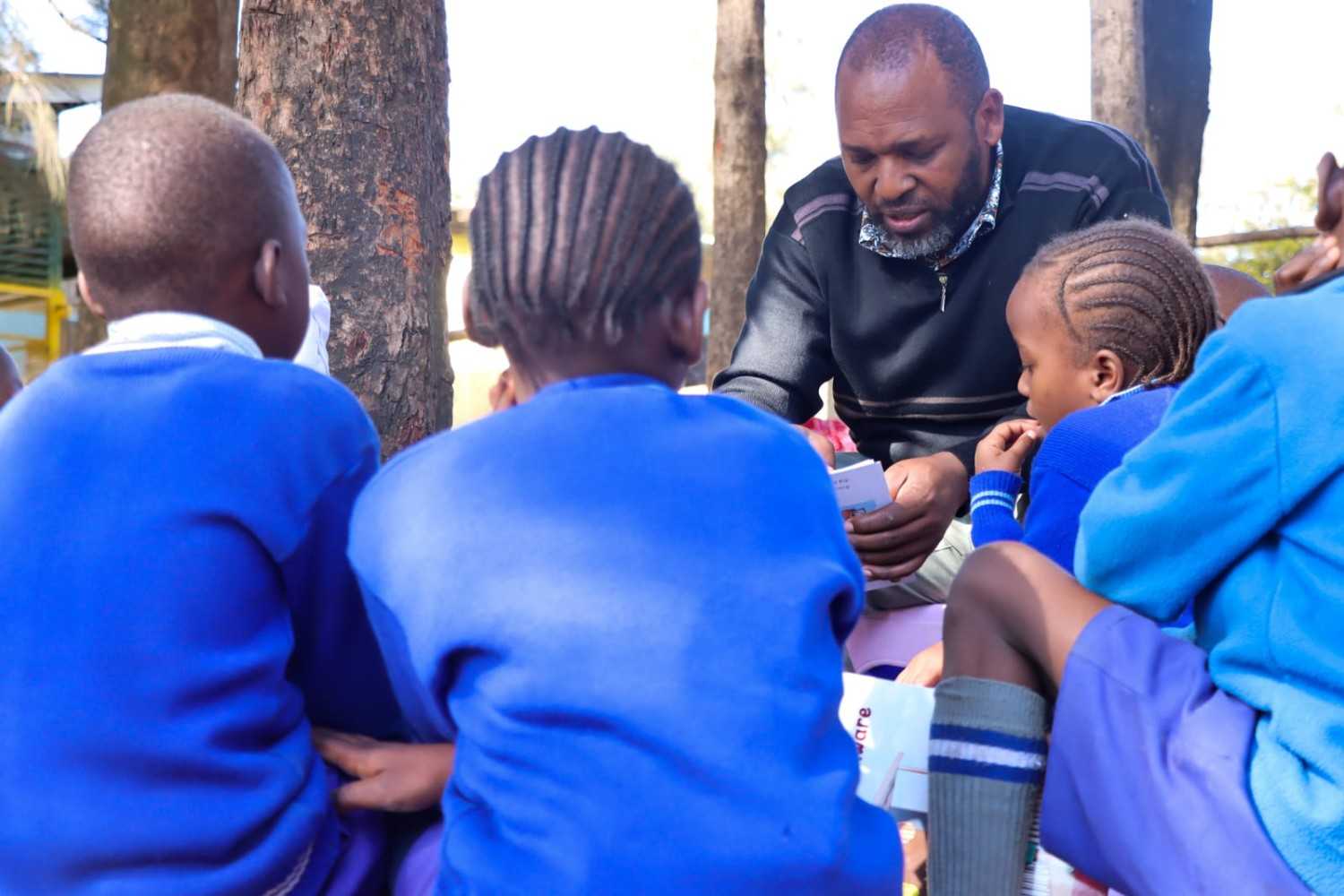
On the 16th of June, instead of attending meetings, writing reports, or sitting in a conference room talking about children, I spent the day with them. I walked into a Grade 2 classroom in Dandora and spent time doing something simple: reading with the children.
It was my first time doing this in this way, not as an assessor, not as a programme officer, but as someone who simply wanted children to be part of the celebration that June 16 is supposed to be. I held up both Kiswahili and English storybooks and told the children to choose the one they wanted to read.
What happened next taught me more than any conference I have attended this year.
They chose English; they could not speak it. Kiswahili told the Story
Every child in the group i was assigned reached for an English book. Not because someone told them to, but because English, in the mind of a Kenyan child, carries a certain weight. It signals intelligence. It signals ambition. It is the language of school, of television, of aspiration.
We read together, interactively, with the kind of engagement that makes reading feel like play. The children were enthusiastic and attentive.
Then I asked them to retell the story.
In English, they struggled; sentences fell apart, and words escaped them. The story they had just experienced with visible delight could not be reconstructed in the language in which it was told.
Then I asked them to tell me the same story in Kiswahili to a colleague.
They came alive. The narrative flowed, the details were sharp, and the expressions were confident and full of personality. The story was exactly the same.
The language made all the difference.
That contrast, vivid and quiet at the same time, sat with me for the rest of the morning and has not let me go since.
The question nobody wants to answer
If a child can understand a story, retell it with clarity, and engage with it meaningfully in Kiswahili, but cannot do the same in English, then what exactly is happening when that child sits in a mathematics class whose instructions are written and delivered in English?
Consider the implications carefully. A child who is fully numerate, who understands number, pattern, sequence, and logic, may sit in an examination and fail. Not because they do not know mathematics. But because the question was asked in a language they have not yet mastered, and the instruction they needed to unlock the problem remained locked behind vocabulary they do not possess.
We call that a mathematics result. Often, it is a language result. And yet we make life-changing decisions about children's futures based on it.
This is not an abstract policy debate. I watched it live, in a classroom in Dandora, with children who were bright, curious, and linguistically capable in ways their school records may never reflect.
June 16, 1976: The day children died for this very reason
The Day of the African Child is celebrated on 16th June every year. It commemorates June 16, 1976, when students in Soweto, South Africa, took to the streets to protest a government directive that mathematics and social studies be taught in Afrikaans, the language of the apartheid government and a language most Black students neither spoke nor understood.
They were not protesting schooling but the use of language as an instrument of exclusion. They understood, with the clarity that only those directly affected can possess, that being forced to learn in a language you do not comprehend is not education. It is an obstacle dressed as education.
The government responded with live ammunition, killing hundreds of young people in one of the deadliest days of South Africa's struggle against apartheid.
The children I read with in Dandora did not know any of this. They could not draw a line between their daily struggle with English instruction and the children who died protesting that same struggle nearly fifty years ago. That is not their failure. That is ours.
History that touches children should reach children
There is a reasonable argument that history, as a formal subject, belongs in the upper primary and secondary curricula, where learners have the cognitive tools to engage with context, chronology, and consequence. That argument is not without merit.
But there is a difference between teaching history as an academic subject and making children aware of events that are directly relevant to their lives. June 16 is not abstract history for a child sitting in a classroom in Kenya trying to understand a mathematics problem written in English. It is their story. It should reach them, even if in a simplified, age-appropriate, and engaging form.
A picture book. A classroom conversation. A teacher who takes five minutes to say: Today we remember children who stood up so that school could make sense. These are not curricular overhauls. They are acts of intentionality, and they cost nothing.
It is also worth saying plainly: several colleagues I spoke with today were not aware why June 16 was the Day of the African Child. If the adults who work in and around education do not carry this history, we cannot expect children to encounter it by accident.
In 2026, the struggle has not ended. It has simply changed its name
The children of Soweto marched against being taught in Afrikaans. In Kenya in 2026, millions of children are learning in English, a language many of them encounter formally for the first time when they start school and have not yet internalised by the time they are expected to use it as a medium of instruction for all subjects.
The Competency-Based Curriculum acknowledged this tension by emphasising the use of the language of the learner's environment in the early years of learning. That was a meaningful step. The question is whether implementation is matching intention, whether children in Dandora, in Turkana, in Kwale, and in Marsabit are genuinely being met where they are linguistically, or whether English is still quietly positioned as the gateway through which all learning must pass.
Language is not merely a medium of instruction. It is the architecture of thought. When a child cannot think freely in the language of their classroom, their thinking is constrained. Their curiosity is constrained. Their potential is constrained. And we measure the constrained output and call it their ability.
What a morning in Dandora reminded me of
I did not go to Dandora to conduct research or to validate a theory. I went to read with children because the Day of the African Child should, at the very minimum, be a day when those of us who work in education actually sit with children.
What I left with was a renewed conviction that foundational learning cannot be separated from the language question, that history must be democratised down to the ages it concerns, and that the most important data in education is sometimes not in a spreadsheet. It is in the face of a child who lights up the moment you ask them to tell you a story in their own language.
The children of Soweto in 1976 asked to be taught in a language they understood. They paid for that request with their lives. The children in Dandora today are still waiting for a full answer to the same question.
At Mizizi Elimu Afrika, we believe foundational learning begins by meeting children where they are. That includes recognising the language they think, dream, question, and learn in. If we are serious about improving learning outcomes, then the conversation about language can no longer remain at the margins of education reform, it must be at its centre.
What language is your child learning? And is it working?