The images are always the same. Thick black smoke rising against a night sky. Students running barefoot across dormitory compounds. The glow of burning mattresses and collapsing rooftops visible from a kilometre away. Then, when the cameras finally arrive, and the dust settles, the unbearable news that a child did not make it out alive.
It happens. We mourn. We hold press conferences. We form investigative committees and task forces. And then we wait, almost knowingly, for it to happen again.
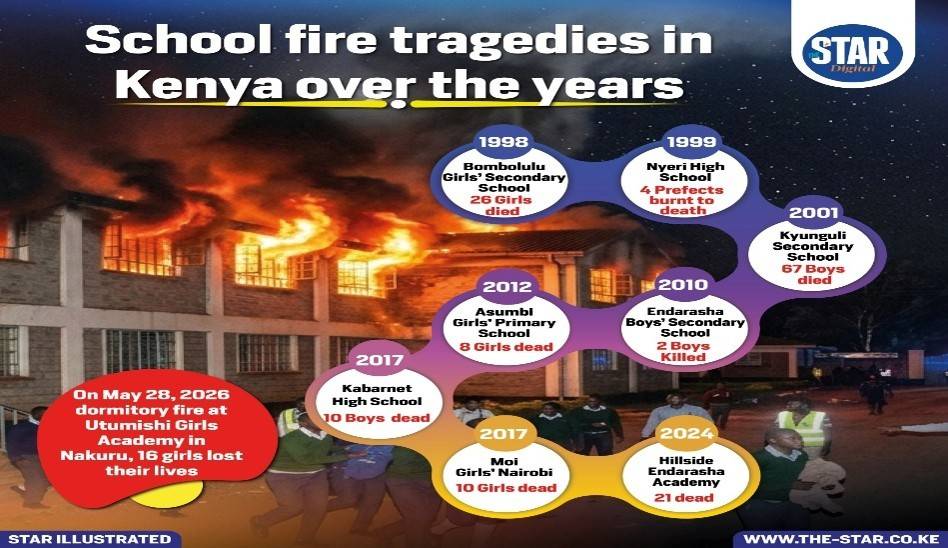
Secondary school unrest is not a new chapter in Kenya's education story. It is a recurring one (see illustration), and its timing is almost clockwork. The second term of the school year arrives with its own particular brand of tension. Longer days, heavier syllabi, students far from home, and a pressure that builds in silence until it does not. Then a spark, and everything burns.
But here is the question Kenya rarely answers honestly: Why do our young people respond to grievance with destruction?
We always blame the wrong things
Every time a school erupts in unrest, the national conversation follows a familiar script. We blame school heads, matrons, absent parents who have outsourced the raising of children to institutions that were never designed to replace a home. We blame social media, which broadcasts every act of rebellion in real time and turns destruction into a spectacle worth replicating. We blame drugs and substance abuse, which have become disturbingly accessible even within school compounds.
We blame the character of an entire generation, calling them ungovernable and disrespectful, as though defiance were simply encoded in their DNA. We blame the length of the second term, which stretches on relentlessly, wearing down students who are far from home, starved of rest, and counting the days to a holiday that feels impossibly distant. We blame examination pressure, pointing to the crushing weight of national and regular assessments and the suffocating expectation that every student must perform at the highest level, as though the fear of failure justifies burning the very institution meant to prepare them for life.
These are not entirely wrong observations. They are, however, symptoms. We have become very skilled at describing the fever while remaining completely unbothered about diagnosing the disease. The root crisis, the one that lies beneath all these contributing factors, is a collapsed value system.
The uncomfortable truth: A nation that stopped teaching its children who to be
Consider this carefully. A student who genuinely understands that human life is sacred does not set fire to a dormitory while his classmates sleep inside it. A student who has been taught to respect what belongs to others does not reduce millions of shillings worth of school infrastructure to ash. A student who has been raised to be his brother's keeper does not walk away while the same brother burns.
These are not complicated ethical frameworks. They are foundational values, and they appear to be disappearing.
The sanctity of life
The willingness to destroy, even when the intent is protest and not murder, signals a profound disconnection from the value of human life. When unrest turns fatal, it is rarely because a student woke up that morning intending to kill someone. It is because, in the heat of the moment, the life of another person did not feel weighty enough to stop the action. That is a values failure. It is the result of a culture that has slowly normalised violence as a legitimate form of expression and agitation.
Respect for the property of others
Schools in Kenya are not private possessions. They are national assets, built through taxpayer contributions, community fundraisers, and generational sacrifice. When a dormitory burns, it is not the government that loses. It is the next generation of students who will study in a tent, the community whose pride was tied to that institution, and the nation whose investment vanished overnight. Destruction of public property is not protest. It is the language of someone who has never been taught stewardship.
Being your brother's keeper
There is an African philosophy that predates colonialism, Christianity, and the Kenyan constitution. Ubuntu: I am because we are. It is the understanding that individual well-being is inseparable from the well-being of the community. When mob action takes root in a school, it survives because bystanders become participants, and witnesses become collaborators in silence. The principle of being a brother's keeper demands something harder than joining the crowd. It demands standing apart from it.
The faith dimension
Kenya identifies as an overwhelmingly Christian nation. Churches fill every Sunday. Scripture verses appear on matatu bumpers and office walls. Yet Galatians 5:22-23[1], which outlines the fruits of the Holy Spirit, concludes with a value that is rarely preached with the urgency it deserves: self-control. Self-control is not weakness. It is the highest expression of personal strength, the ability to restrain oneself even when the grievance is legitimate, even when the anger is real, and even when the temptation to retaliate feels overwhelming.
This obligation is particularly pointed for church-sponsored secondary schools, of which Kenya has a significant number. The Catholic, Protestant, and other faith-based institutions that founded and continue to sponsor many of our schools carry a responsibility that goes far beyond offering Mass, catechism and determining who becomes a Head of Institution. If a school bears the name of a church, a diocese, or a Christian mission, then the values espoused from its chapel must be visible in how its students conduct themselves when the lights go out, and the supervisors are asleep. A church-sponsored school that produces students who cannot exercise self-control in a moment of crisis has separated its faith from its formation. The sponsoring church must ask itself, honestly, whether its presence on the school board is a genuine investment in the moral character of its students or simply a matter of institutional prestige.
A faith that does not produce self-control in the face of adversity has not yet taken root in the daily character of its people.
The missing curriculum: Values and life skills we must teach
Beyond the three foundational values above, there is a broader set of competencies that Kenyan schools, families, and communities must urgently prioritise.
Emotional intelligence is the ability to identify, name, and manage one's emotions before they escalate into destructive decisions. Young people must be taught that anger is a valid human emotion, but that the response to anger is always a choice. When students have no vocabulary for what they are feeling, and no framework for processing it, fire and rampage become their language.
Conflict resolution is the skill of raising genuine grievances without resorting to violence. Student councils, peer mediation programmes, and structured open-dialogue forums are not luxuries. They are safety valves. When students believe no one will listen unless something burns, the solution is not stricter punishment. It is creating a credible space where they are heard.
Empathy and compassion require the active practice of seeing the world through another person's eyes, whether that person is a classmate who could be trapped, a teacher who devoted their career to education, or a night guard who was simply doing his job. Empathy is the bridge between self-interest and communal responsibility, and it must be cultivated deliberately.
Accountability and personal responsibility form the counterweight to a culture of blame. Students must be raised to understand that their choices carry consequences, and that the measure of character is not how one behaves when things are easy but how one behaves when things are hard. Discipline rooted in accountability produces adults who take ownership. Discipline rooted in fear alone produces adults who only behave when someone is watching.
Civic consciousness connects the individual student to the larger society. A student who understands that a school laboratory represents the taxes of thousands of Kenyan families thinks differently before picking up a matchbox or a stone. Civic education must go beyond memorising the three arms of government. It must cultivate genuine love for and ownership of public goods.
Resilience and coping skills acknowledge that life will be difficult. The second term will be long. Examination pressure will be immense. Homesickness will be real. Resilience is not the absence of struggle. It is the capacity to endure struggle without falling apart, burning or breaking things down.
Values must be lived, not just learned
It is not enough, however, to teach these values within the four walls of a classroom and consider the work done. Values encountered only in a school setting remain academic. They become real and lasting only when they are reflected in the world that students return to every time they go home.
A child who is taught to respect human life at school but watches adults in their community resolve disputes with violence will not carry the school lesson very far. A teenager who learns about accountability in a civics lesson but observes corruption, impunity, and double standards modelled by the adults around them will quietly conclude that values are for classrooms and not for real life. Children do not primarily learn from what they are told. They learn from what they consistently observe.
This means that the responsibility for the formation of values extends to every adult within a young person's ecosystem. The parent who jumps a queue, the employer who demands a bribe, the neighbour who settles an argument with insults, the leader who uses public resources for personal gain- each of these is a values lesson delivered without a textbook. For values such as self-control, respect, empathy, and civic responsibility to move from school content to national culture, they must first be visible in how we, the adults of this nation, conduct ourselves in traffic, in markets, in offices, in homes, and in every space that young eyes are watching.
The goal is not merely to produce students who can recite the right answers in a life skills examination. The goal is to cultivate a generation that has grown up inside a culture where integrity is the norm, where restraint is admired, and where the sanctity of life and property is not a topic taught between 8 a.m. and 4 p.m. but a value breathed in from every corner of their world. That culture will not emerge from schools alone. It must be built by all of us, starting now.
The responsibility is shared
None of these sits on a single set of shoulders.
Parents must re-engage with the moral formation of their children before they arrive at the school gate. The values a child carries into Grade 10 were planted, or neglected, long before that moment.
Teachers and school administrators must build environments where students feel genuinely heard, not just managed. A student who trusts that a legitimate complaint will receive a legitimate response is far less likely to resort to destruction.
Government and policymakers must integrate values education into the Competency-Based Curriculum in a meaningful and measurable way, not as a footnote subject but as a pillar of national character-building.
Religious institutions and school sponsors must translate their theology into practical mentorship for teenagers navigating one of the most turbulent seasons of their lives. Sponsoring a school is not merely a historical legacy to be commemorated at prize-giving days. It is a living, active obligation to shape the souls of the students within those walls.
And students themselves carry a responsibility that should not be minimised. Young people who model self-control, empathy, and integrity in the face of peer pressure do not simply protect themselves. They shift the moral climate of an entire school.
A Call to Conscience
The fire trucks will eventually leave. The school will be rebuilt. A commission of inquiry will produce a report that sits on a shelf. And somewhere in Kenya, a dormitory is already smouldering in preparation for the next cycle.
The real rebuild does not happen with cement and iron sheets. It happens in the conscience of a nation that finally decides, with conviction and urgency, that values matter, that character is not accidental, and that the kind of young people Kenya produces is a direct reflection of what Kenya chooses to teach them, in homes, in classrooms, in pulpits, and in the quiet example of every adult they watch.
The question, then, is not only why do our schools keep burning?
The question is: What values are you planting in the young person within your reach?
Charles Gachoki (PhD) is the Research Manager at Mizizi Elimu Afrika