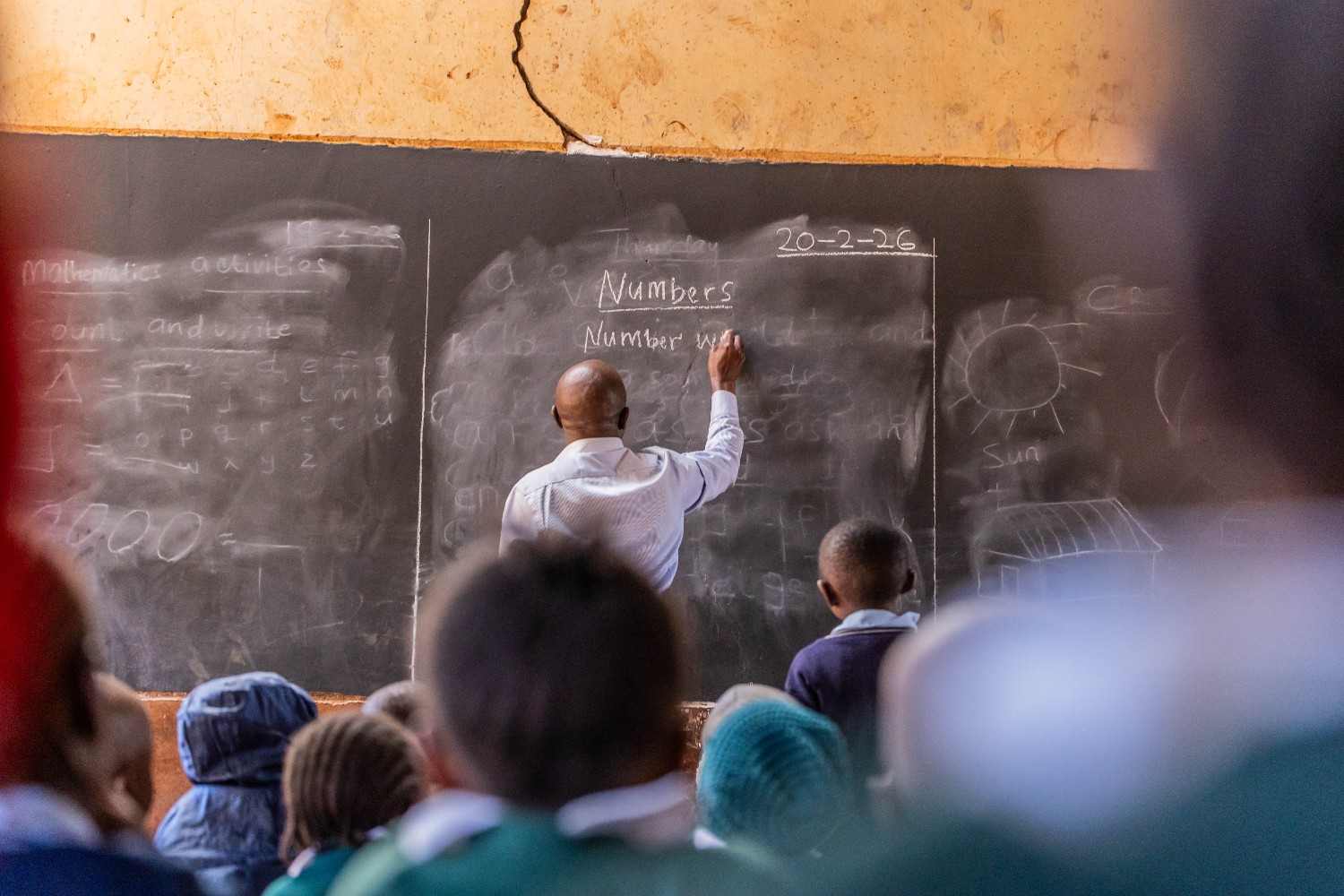
During one of our Error Analysis sessions in Bungoma County, I found myself looking through a learner's mathematics exercise book. At first glance, there was little to worry about. The child answered the question correctly. Any teacher moving quickly through a pile of exercise books would probably have placed a tick beside the answer and moved on.
But someone in the room paused.
Instead of asking whether the answer was correct, they asked a different question: How did the learner arrive at it?
Looking more closely, it became apparent that the child had counted sticks to solve a problem that, at that stage of schooling, should have been answered mentally. The answer was correct, but the strategy revealed that the learner had not yet developed the mathematical understanding expected of a child at that level.
That moment captures a challenge that extends far beyond one classroom in western Kenya. Much education is designed to reward correct answers. Assessments tell us who passed, who failed, which schools improved, and which counties are performing well. These measures are undoubtedly important, but they tell only part of the story. They reveal outcomes without always revealing the thinking that produced them.
The more we reflected on classroom practice during our work with teachers, the more we realized that learner errors are not simply mistakes to be corrected. They are evidence. They tell us where understanding begins to break down, what misconceptions learners hold, and, perhaps most importantly, what teachers need to do next.
That may sound obvious, yet it represents a significant shift in how we think about assessment.
Traditionally, assessment has been treated as a way of measuring learning after it has occurred. A learner completes an exercise, the teacher marks it, and the class moves to the next topic. In practice, this often means that assessment becomes an endpoint. By the time misconceptions are identified, the class has already moved on.
Error analysis turns this sequence around. Instead of treating learner responses as the final product of instruction, it treats them as the starting point for better teaching. Every incorrect response, and sometimes a correct one too, becomes an opportunity to understand how a learner is reasoning. The question changes from "Did the learner get it right?" to "What does this answer tell me about how the learner is thinking?"
That distinction matters because mathematical learning is cumulative. A weak understanding of place value today becomes difficult with subtraction tomorrow, with fractions next year, and with algebra later. When misconceptions remain hidden, they do not disappear. They accumulate.
One of the most interesting lessons from our work was that teachers themselves began to change in unexpected ways. Initially, many saw learner errors primarily as something to correct. Over time, they started discussing patterns of misconceptions instead of isolated mistakes. They became more deliberate in questioning learners, more curious about different solution strategies, and more willing to adapt lessons based on what they observed in the classroom.
In many respects, the most important outcome was not that teachers learned a new technique. It was that they developed a different way of looking at learning itself.
This has implications that reach well beyond mathematics.
Across many education systems, considerable effort is invested in curriculum reform, new textbooks, digital learning platforms, and teacher training. These investments are necessary, but they often focus on what teachers should teach rather than how teachers interpret evidence of learning while teaching. Yet classrooms are dynamic environments. Every lesson produces information about what learners understand, what they misunderstand, and where they are struggling. The real challenge is whether teachers are equipped to use that information to make better instructional decisions.
Our research suggests that this capacity, what we describe as diagnostic reasoning, may be one of the most important, and least discussed, dimensions of effective teaching. It is the ability to recognise that two learners who produce the same incorrect answer may have arrived there for entirely different reasons. It is the ability to distinguish between a careless mistake, a procedural error, and a conceptual misunderstanding. More importantly, it is the ability to respond differently to each of them.
This way of thinking also changes how we understand professional development. Too often, teacher training is measured by the number of workshops conducted or the number of teachers reached. Those metrics are easy to report, but they tell us little about whether teachers are making different instructional decisions once they return to their classrooms. Professional learning matters most when it changes judgement, when teachers begin to see learners differently and, as a result, teach differently.
The findings also challenged an assumption that frequently surfaces in discussions about mathematics education. Throughout the intervention, girls consistently performed better than boys in foundational numeracy. The study was not designed to explain why this occurred, and it would be unwise to draw sweeping conclusions from a single context. Nevertheless, it serves as a reminder that educational assumptions should always be tested against evidence. Effective policy begins with careful observation rather than inherited beliefs.
Perhaps the broader lesson is this: improving education is not always about finding new answers. Sometimes it is about asking better questions.
Instead of asking whether learners are getting the right answers, we might ask whether they are developing the right understanding. Instead of asking whether teachers completed the lesson, we might ask what they learned about their learners while teaching it. Instead of viewing assessment as a tool for judging performance, we might begin to see it as a source of insight that can shape the next lesson, the next question, and the next opportunity to learn.
The child in Bungoma who counted sticks to answer a simple addition problem unknowingly offered a lesson that extends far beyond mathematics. The exercise book did not simply reveal whether learning had occurred. It revealed how learning was unfolding.
And perhaps that is where educational improvement truly begins, not with better marks alone, but with a deeper curiosity about the thinking behind them.