
Kenya has spent two decades expanding access to education, reforming the curriculum and building institutions capable of serving children at scale. Primary enrolment has crossed the 86 per cent threshold, placing the overwhelming majority of children within reach of the education system. Access gaps remain for some communities and must continue to be addressed, but access is no longer Kenya's principal national bottleneck. Our defining challenge is whether children who enter school acquire the literacy and numeracy skills on which all later learning depends.
That is the question Kenya's delegation carried into the 2026 Lighthouse Coalition immersion in India. The visit explored NIPUN Bharat, the National Initiative for Proficiency in Reading with Understanding and Numeracy, India's mission to ensure that every child develops foundational literacy and numeracy by the end of Grade 3. The most important lesson was not a single programme, digital platform or classroom technique. It was the deliberate organisation of an entire system around one measurable promise to children.
NIPUN Bharat turns foundational learning from one education activity among many into a visible national mission with clear targets, aligned institutions and accountability from the classroom to the centre.
NIPUN Bharat is a system discipline, not simply a programme
NIPUN Bharat operates in mission mode. National direction is translated through state, district, block, cluster and school structures. Each level knows the foundational learning goals, the support it must provide and the evidence it must examine. Curriculum, teacher guides, learning materials, assessments, coaching and communication are designed to reinforce the same outcomes.
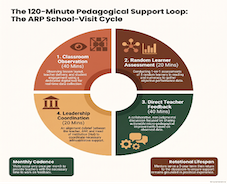
The mission also makes the middle tier matter. Academic Resource Persons visit schools to observe lessons, assess a small sample of learners (usually five), give teachers practical feedback, engage school leaders and provide a 30-day window before returning for follow-up. Their work is primarily pedagogical. The purpose is not to police teachers or complete compliance forms; it is to help the classroom improve. Data, therefore, becomes a working instrument: it identifies the child who is behind, the competency that has not been mastered, the teacher who needs support and the block or district that requires a different response.
At the beginning of each academic year, learners are assessed against the benchmarks and competencies they are expected to have attained. This serves as a baseline for the new grade and guards against learners falling so far behind that they lose motivation and eventually drop out. That safeguard matters, because there is no major assessment at the foundational level. Foundational learning is meant to welcome the child into learning, to help them feel valued, and to create positive relationships with the teacher and to build trust between school and home.
This is what NIPUN Bharat means for Kenya. It shows what becomes possible when a country connects political leadership, institutional mandates, teacher support and learner evidence around a small number of non-negotiable learning outcomes. India's scale and governance arrangements differ from Kenya's, so its model cannot simply be copied. But its organising logic is directly relevant: define the national promise, align every actor behind it, measure progress frequently and act when the data shows that children are not learning.
Kenya already has the architecture
Kenya does not need to create an education system from the ground up. We already have Curriculum Support Officers (CSOs) with a mandate to strengthen teaching; Quality Assurance and Standards Officers (QASOs) with a mandate to safeguard quality; Heads of Institution (HOIs) who can lead instruction within schools; and county, sub-county and national leaders who can coordinate implementation and remove obstacles.
We also have the right institutions. The Kenya Institute of Curriculum Development (KICD) can align the curriculum, teacher guides and learner materials. The Kenya National Examinations Council (KNEC) can define clear grade-level benchmarks, provide fit-for-purpose diagnostic tools, and help the system interpret learning evidence. KNEC can also help institutionalise the Kenya School Readiness Assessment Tool (KISRAT) for school readiness at the end of Pre-Primary 2. The Ministry of Education, the Teachers Service Commission, county governments, teacher education institutions and school leadership associations all play essential roles in the delivery chain.
The problem, then, is not institutional absence. It is institutional coherence. Too often, the curriculum says one thing, the assessment measures another, teacher development arrives as a one-off event, classroom supervision emphasises compliance, and data travels upward without returning to the teacher as guidance that changes classroom practice. The parts exist, but they do not consistently move as one system around the child.

Delegation leaders from six countries reflect on how national missions can turn institutional mandates into better learning for every child.
Kenya's persistent gap: data that reports, but does not always drive action
Kenya generates substantial education data through national assessments, school records, quality assurance visits, teacher appraisal processes, programme evaluations and citizen-led assessments. Yet we have persistently failed to make data the routine basis for decisions and accountability. Results are often reviewed too late, aggregated too broadly or discussed too far from the classroom to change what a teacher does with a struggling learner the next morning.
This is the reform gap NIPUN Bharat exposes most clearly. Data has value only when it triggers a response. If Grade 2 learners cannot add and subtract within an agreed range, the evidence should immediately shape teacher coaching, lesson planning, remediation time and the allocation of learning materials. If a school is not improving, the HOI, CSO and QASO should see the same evidence, agree on the next action and review whether it worked. If several schools show the same weakness, sub-county, county and national leaders should treat that pattern as a system problem rather than an individual teacher failure.
Accountability must therefore be developmental, and it must be acted upon. It should ask not only whether an officer visited a school or a teacher completed a form, but whether the visit improved instruction and whether more children are reading with understanding and using numbers confidently. The child-level outcome must be the line of sight connecting the classroom, the school, the middle tier and national leadership.
What Kenya should do now
Complete one national foundational learning framework and strategy
Kenya needs an adopted, costed and time-bound framework covering the full foundational stage from pre-primary through Grade 3. It should establish common literacy and numeracy outcomes, clarify the roles of national and county governments, assign institutional responsibilities and define how progress will be financed, monitored and publicly reviewed.
Set a small number of clear, grade-specific learning targets
Teachers, parents, HOIs, CSOs and QASOs should be able to state what every child is expected to know and do at each stage. These targets must be reflected in the curriculum, teacher guides, textbooks, timetables, classroom assessments and national monitoring tools.
Turn the middle tier into an instructional support engine
CSOs and QASOs need manageable caseloads, facilitation, appropriate digital tools and a protected mandate to support pedagogy. School visits should combine classroom observation, a rapid check of learner understanding, specific feedback to the teacher and an action-oriented discussion with the HOI.
Give HOIs responsibility for foundational learning
Institution-Based Quality Assurance should make instructional leadership real. HOIs should routinely observe early-grade lessons, review learner-level evidence, organise school-based support and ensure that children who fall behind receive structured remediation.
Build a data-to-action accountability cycle
Every assessment should answer three practical questions: Which children have not mastered the expected skill? What support will they receive? Who will check whether that support worked? Dashboards and reports are useful only if they shorten the distance between evidence and action.
Put the child in the boardroom
Kenya's next foundational learning reform should not be another temporary project layered onto existing structures. It should be the disciplined activation of the structures we already have. NIPUN Bharat's deepest lesson is that a country can convert an ambitious learning goal into daily administrative and instructional practice when leadership is sustained, roles are clear, data is visible to all, and every level including the public, is accountable for acting on it.
The division of responsibility between national and county governments need not become a division of purpose. Pre-primary and primary education may sit within different mandates, but the child's learning journey is continuous. A child does not experience government as separate institutions; the child experiences whether the lesson makes sense, whether the teacher receives support and whether someone notices when learning has stalled. A similar situation plays out at school level. Whether or not a school has an ECDE manager, the Head of Institution is the school authority and the unifying factor. That is how the child and the parent see it, and that is what the system should support. We cannot have two centres of power when accountability is what we seek: the buck has to stop with someone.
“Even when foundational learning is an intergovernmental ecosystem, when the child is at the centre of our attention, we can achieve it; all we need to do is to bring the child to the boardroom.”— Director General, Basic Education
All Kenya needs now is to complete, adopt, finance and implement a national Foundational Learning Framework and Strategy, and use it to make every institution, every leader and every school accountable for every child learning.
Sources and further reading
This blog draws on the Kenya delegation's NIPUN Bharat immersion report and the following public sources.
Lighthouse Coalition Kenya Delegation, Foundational Literacy & Education Reform Strategies in India: A Comprehensive System Immersion & Technical Report for Delegation Leadership (August 2026).
UNICEF Kenya, Education overview and national primary enrolment context.
World Bank / UNESCO Institute for Statistics, Kenya primary gross enrolment ratio.
Government of India, Department of School Education & Literacy, NIPUN Bharat.
Government of India Press Information Bureau, launch and official objectives of NIPUN Bharat.
Kenya Demographic and Health Survey (KDHS), 2022.