
What we learned on Day 1 of the Evidence for Education Network workshop in Naivasha
A teacher attends a training workshop and returns to school. What support helps them use what they learned? A ministry wants to direct funding to the schools with the greatest needs. What evidence can guide that decision? A researcher completes a study. How does it reach the official, school leader or teacher who could act on it?
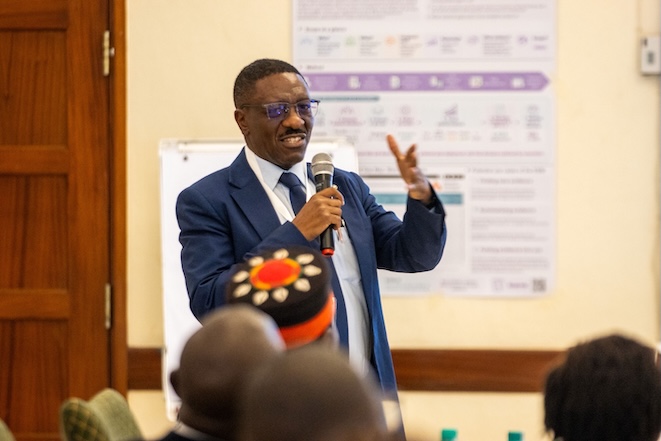
These questions shaped the opening day of the Evidence for Education Network (EEN) workshop, which opened in Naivasha on 25 November 2026. Co-hosted by Mizizi Elimu Afrika and eBASE Africa, the workshop brings together researchers, government officials, universities, funders and organisations working to connect education research with policy and practice.
Under the theme “Harambee Ushahidi! Priorities, technology and action in education” (Harambee Ushahidi means roughly “Let’s pull together for evidence”), participants examined how evidence is produced, shared and used. Government representatives brought specific problems they need help solving. Researchers shared findings and approaches that could help. Network members began identifying the work they could take on together over the next 18 months.
Start with the decisions education systems face
Opening the day, Fredrick Mujumba, Director Kenya Education Management Information System (KEMIS) at the Ministry of Education, described the challenge of serving millions of learners with limited resources. The Ministry holds substantial data, but some of it sits in different institutions. Bringing it together could help officials see where interventions are needed and how resources could be used more effectively.
He used differences in classroom ratios across counties to show why the way data is presented matters. National averages can hide wide variation between places. Decisions about classrooms, teachers and funding require a closer understanding of the conditions learners actually experience.
That led to a financing question: what evidence would help Kenya move towards allocating school funding according to need? With foundational learning in focus, the Ministry wants to understand what such an approach could mean for learners in Grades 1–3. Mujumba said an initial search for relevant studies had not yet produced the answers officials need.
He also outlined the Ministry’s ambition for an education evidence hub. It could bring together existing research and data, support comparisons between policies and programmes, produce decision briefs and help track whether recommendations are implemented. The aim is a tool officials can query when they are making decisions.
His contribution gave the workshop a concrete starting point. An education system may already have plenty of information and a clear question, yet still need help finding and interpreting the evidence that can inform its response.
A network built on mutual learning
The opening session also marked a change in EEN’s leadership.
Jon Kay, the outgoing chair, reflected on the network’s purpose and the value of learning across education systems. EEN brings together organisations with different responsibilities, resources and ways of working, united by a commitment to improving education equity through better use of evidence.
Kay highlighted eBASE Africa’s experience in storytelling and research communication, and its attention to whether findings from one setting can apply in another. He also recognised Mizizi Elimu Afrika’s work with government, universities and other education partners, including its role in strengthening evidence synthesis capacity.
He encouraged members to arrive with a problem they wanted help solving and to use the workshop to find collaborators. Invited partners were urged to question assumptions and share approaches the network could learn from.
Patrick Okwen of eBASE Africa then introduced the next phase of EEN’s work. Under a new rotating arrangement, eBASE Africa will lead the network for 18 months, with the Education Endowment Foundation continuing as secretariat.
Okwen described the leadership role as one of listening, connecting organisations and supporting collective work. The network’s new Learning Agenda will give members a way to set priorities and turn those connections into activities.
He also argued for making greater use of evidence already available in African contexts. Examining existing data shows what it can answer, where it falls short and what should be improved. He cited the Unlocking Data Initiative as part of the effort to make local evidence easier to access and use.
Governments’ questions brought the discussion into schools
A panel on evidence synthesis in African education systems showed how varied the demand for evidence can be.
For the Early Childhood Development and Education (ECDE) representative from Machakos County, early learning depends on a combination of qualified teachers, suitable classrooms, play materials, feeding and access. In communities far from schools, he stressed the importance of finding nearby spaces where young children can learn and receive care.
He also shared the county’s experience of introducing digital learning in pre-primary classes (PP1 and PP2) from January 2026. Devices carry age-appropriate activities, including literacy, numeracy and recognition of familiar objects. Using them requires teacher training, electricity and connectivity, and the county is exploring offline options for places where internet access is limited.
This raised a further question about evaluation. Knowing which schools have devices and which teachers have been trained is a starting point. Participants also wanted to know what children are learning through the devices and what evidence is available to guide expansion.
From Cameroon, Tohmoh Joseph asked participants to consider teachers’ working conditions. Teachers in remote areas may need support with their own literacy and numeracy, while those in conflict-affected communities also face threats to their safety and psychosocial well-being.
He described a recruitment approach that advertises vacancies for specific schools and seeks applicants with a connection to those areas. Yet the same schools often keep losing teachers as recruits seek transfers. His question for researchers: what helps teachers stay in places where staffing is persistently difficult?
School closures in parts of Cameroon’s Northwest and Southwest regions pose another challenge. When schools cannot operate, teachers sometimes gather learners in homes or halls. The panellist asked whether any teaching models had been tested in such conditions, and what evidence could help teachers organise foundational learning there.
These contributions showed why the question “What works?” needs more detail. What works for which learners, in which setting, with what support and under what constraints?
KICD invites research on foundational numeracy
Dr Jacqueline Onyango Deputy Director Kenya Institute of Curriculum Development (KICD) described research as a resource for developing and improving the curriculum.
She pointed to how hard it can be to help educators adopt new teaching approaches, even when priorities such as literacy, numeracy and social skills are well established. Mathematics is one example: evidence can help teachers improve how they teach familiar content as learners’ needs and classroom practice evolve.
KICD works through panels that include teachers, universities, Ministry officials and other stakeholders. Researchers can contribute by making their work known and engaging through those processes.
Her invitation is especially timely for ongoing work on foundational numeracy, including an upcoming pre-testing study. Curriculum teams lack the time and funding to commission every study they need, so existing findings can help them understand what is working, identify gaps and consider adjustments.
She also highlighted access. Researchers were encouraged to share their studies and explore ways to make them discoverable through KICD’s education cloud and library links. For evidence organisations, this offers an immediate route for follow-up.
Universities can connect research with teacher preparation
A session on universities and the evidence synthesis ecosystem examined how research can become part of the institutions that prepare and support teachers.
The Education Deans Forum Kenya presented its university network as a platform for collaboration. Schools of education bring expertise across disciplines, supervise postgraduate research and work with teachers both before and after they enter the classroom.
The Forum identified teacher preparation and continuing professional development as key opportunities for evidence use. Research can inform course content, practical training and support for teachers already in service. The Centre for Mathematics, Science and Technology Education in Africa (CEMASTEA) was highlighted as an existing platform for strengthening teachers’ practice.
The Forum also described its work with the Commission for University Education as universities prepare for the first cohort from Kenya’s competency-based education system, due to arrive in 2029. The reforms create an opportunity to examine what future teachers need to know and how they are prepared.
Universities could collaborate through shared supervision, support for early-career researchers and joint work on national research priorities. Research chairs were presented as a way to build sustained expertise in areas such as foundational numeracy and literacy.
HERI Africa: connecting research priorities, capacity and funding
Dr John Mugo, Executive Director of Mizizi Elimu Afrika, presented Harnessing Education Research for Impact in Africa (HERI Africa), a Mizizi programme, and described the barriers that keep African education research from reaching the people who could use it.
Much research remains in theses, unpublished reports or other formats that are hard to find. Researchers may have limited support, and funding often shapes the questions they can pursue. Teachers, communities and policymakers struggle to access findings relevant to their decisions.
HERI Africa responds through several connected areas of work.
The first is Kenya’s National Education Research Agenda. Its development began with questions drawn from government policies, strategies and other documents. These were grouped into nine themes so that universities, students and funders can see where research can respond to national needs.
The second is research capacity. HERI Africa is supporting stronger supervision and early-career research, alongside work to establish a Centre for Education Research and Innovation at the Commission for University Education.
Research chairs offer a longer-term way to build expertise and connect studies within a theme. The University of Embu’s work on foundational numeracy and mathematics education was one example shared during the day.
HERI Africa is also working on research access and communication, including stronger African journals and more routes for findings to reach users. Its funding approach seeks greater participation from governments, African philanthropy, universities, diaspora networks and international partners.
Asked how research could be coordinated across countries, Mugo emphasised country-owned agendas. Countries can identify their own priorities, build partnerships around them and then collaborate regionally where questions overlap. The continental ambition depends on institutions being able to sustain that work in their own settings.
Five reflections from Dr Sara Ruto on getting evidence used
In her keynote, Dr Sara Ruto drew on her experience across research, government and funding. She recalled the early Uwezo household learning assessments, when the team had a large volume of data and many findings to communicate. Advisers urged them to make the results understandable, so that people could connect the numbers with the lives behind them.
She offered five reflections.
First, begin with a question the intended user is asking. A national research agenda helps researchers, supervisors and funders connect their work to the decisions government needs to make. Understanding that demand early gives findings a clearer route to use.
Second, build local knowledge into research. She cited the Kiswahili proverb Akili ni nywele, kila mtu ana zake—wisdom is like hair, everyone has their own—to recognise the knowledge held by communities and implementers. The framing, language and interpretation of research should reflect those realities.
Third, pay attention to timing. A directive, reform or leadership change may open a short window for evidence to inform policy. Researchers need to know when decisions will be made and what they can share in time.
Fourth, fund research at a scale that suits the question. Research intended to inform national decisions needs appropriate resources. She discussed collaborative funding and investment in the institutions and people who can sustain research over time.
Fifth, build trust through repeated, honest engagement. Researchers and officials need opportunities to understand each other’s responsibilities and constraints. That relationship matters most when results are difficult to hear.
In the Q&A, Ruto stressed that findings should not be watered down when they challenge a government’s position. Researchers should consider who has the authority to act and how best to reach them. A direct briefing may open a route to action; advocacy and public debate may be needed when other routes stall.
On data sharing, she encouraged researchers to start with government datasets that are already open and to build the skills to analyse them. Organisations that connect institutions can also help bring information together around a shared problem.
What happens after a teacher training workshop?
Two Mizizi Elimu Afrika graduate associates gave the day a detailed example of evidence synthesis in practice. Victor Saoke and Christine Nzomo of the University of Embu, who work with Mizizi under the Unlocking Data Initiative, developed their review through training at the IDRC-supported Evidence Synthesis Academy.
The review examined teacher professional development strategies, how they were implemented and how effective they were reported to be. It covered 36 studies from 15 countries, 24 of them from sub-Saharan Africa, including nine from Kenya.
Workshops and cascade training were the most common approaches, followed by coaching. Twenty programmes combined two or more approaches.
The presenters focused on what happens after training. Examples from Kenya, Ethiopia and England showed that planned coaching, supervision and peer observation were difficult to deliver consistently, and that effects were larger where follow-up was delivered well.
Implementation also depended on school conditions. Materials, connectivity, workload and scheduling were common barriers. Collaboration among teachers, support from school leaders, protected time and practical guides helped teachers apply what they had learned.
Their recommendations included stronger school-based coaching, classroom observation and feedback, practical curriculum-aligned teacher guides and joint monitoring.
The review left participants with a question to take back to programme design and budgeting: what support will teachers receive when they return to their classrooms, and how will we know whether it is delivered?
Building EEN’s first Learning Agenda
In the afternoon, the focus turned to the network’s own priorities.
A survey of 10 member organisations provided the starting point for EEN’s first Learning Agenda. Members and invited partners were asked to validate the findings, identify where they could learn together and consider what success would look like over 18 months.
Primary education was a high priority for all respondents. Implementation and process evaluations also featured strongly, alongside policy guidance, teacher guides and approaches to communicating evidence.
Members want to learn more about AI tools, knowledge brokering, evidence transferability and scaling up evidence use. They also identified political and institutional barriers, limited staff capacity and difficulty measuring impact.
An interactive Mutual Marketplace helped organisations make their offers and needs visible. Participants created posters showing the expertise they could share, work under way and challenges where they wanted support. The organisers plan to turn the posters into a directory to help partners reconnect after the workshop.
Three priorities for putting evidence into practice
The Evidence into Practice breakout group organised its discussion around three learning areas.
The first was AI for producing and using research, with equity built in. Participants asked how AI could help teachers and policymakers engage with evidence while giving research from the Global South greater visibility. They raised concerns about whose studies these tools can draw on and whose questions shape the evidence being produced.
The second was knowledge brokering, including transferability and scaling. Members discussed how to turn syntheses into practical guidance, involve users from the start and help them judge whether findings apply in their setting.
The third was systems approaches to evidence use. Participants described the challenge of moving from policy ambition to implementation. Governments may need support to organise funding, teacher training, delivery and monitoring. Teachers may need protected planning time, materials and leadership support before a recommended practice becomes feasible.
The group suggested webinars, case studies and practical guidance as possible outputs. Its broader ambition is for organisations to show meaningful changes in how they work as a result of shared learning.
Other groups reinforced the need for collaboration. The Evidence Generation group proposed sharing methodological skills and documenting research choices and trade-offs, including those involved in EdTech and AI. The Policy group highlighted teacher preparation and professional development, evidence transferability, joint advocacy and stronger partnerships with government.
What we take into Day 2
Day 1 connected education research with decisions people are already trying to make. It also showed how much work lies between a finding and its use. Research needs to be accessible, interpreted in context and available at the right time. People need support to act on it, and institutions need ways to sustain and assess that action.
For Mizizi Elimu Afrika, the discussions connect directly with our work on foundational learning, teacher support and stronger education research partnerships. The questions raised in Naivasha open up opportunities for follow-up with government, universities and fellow EEN members.
Day 2 turns to EdTech, AI and evidence synthesis. Discussions will build on the questions already raised: how technology can strengthen research and education decisions, what evidence is needed to assess its contribution, and how its benefits can reach learners in different contexts.